
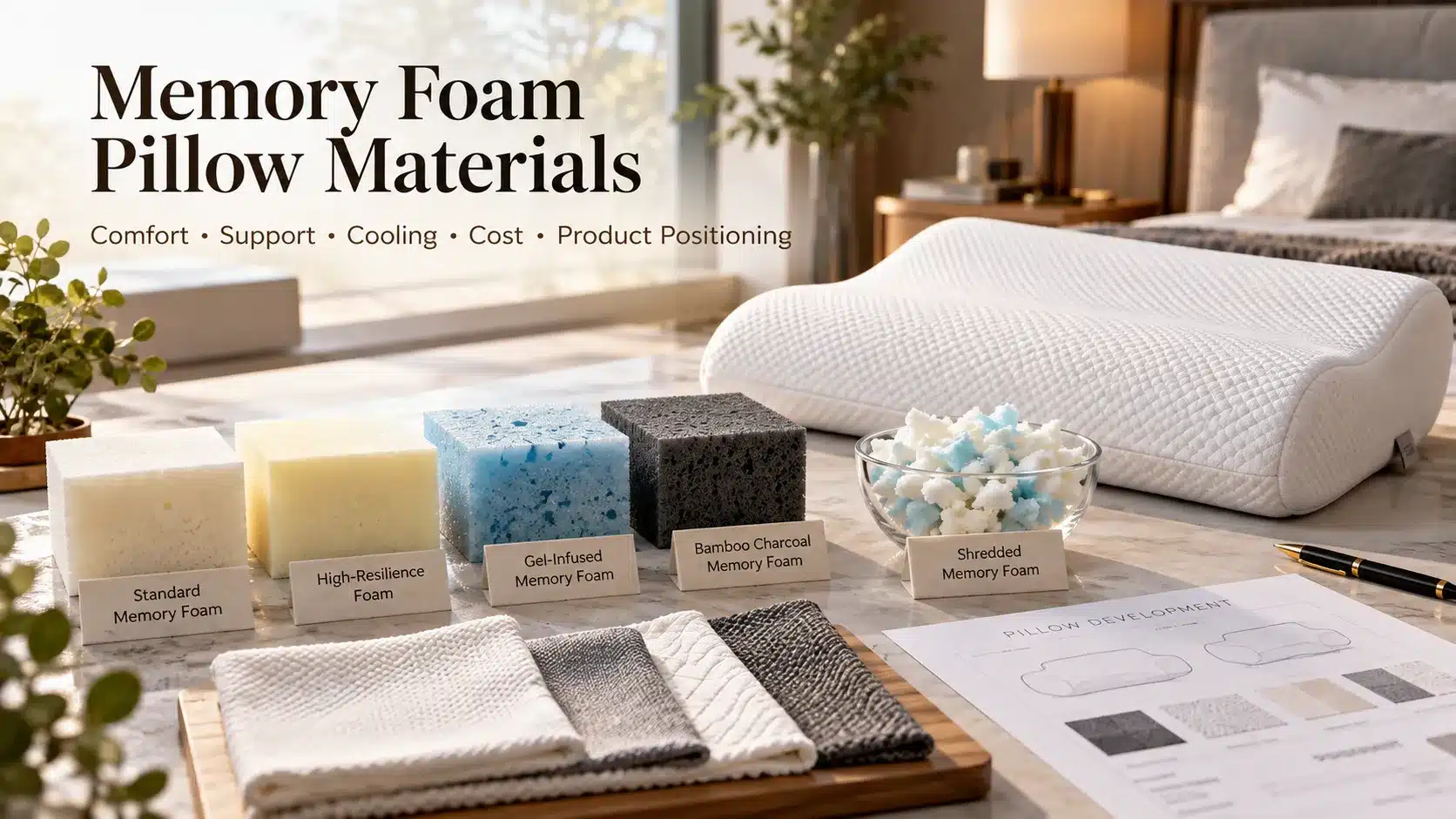
Choosing the right foam is one of the most important decisions when developing a memory foam pillow. The foam affects comfort, support, recovery speed, cooling performance, durability, product weight, and manufacturing cost.
There is no single best foam for every pillow. The right material depends on the pillow type, target customer, desired firmness, retail price, and product positioning.
For pillow brands, Amazon sellers, importers, and distributors, the goal is to choose a foam that delivers the required performance without adding unnecessary cost or complexity.
What Should Brands Consider When Choosing Pillow Foam?
The right foam should match the complete product design.
Before selecting a material, brands should confirm:
- Pillow type
- Target firmness
- Pillow height
- Support requirement
- Cooling requirement
- Product price level
- Compression packaging
- Expected durability
The most expensive foam is not always the best choice. A successful product needs the right balance between comfort, support, cost, and market positioning.
Standard Memory Foam
Standard memory foam is one of the most widely used materials for pillows.
Its main characteristics include:
- Slow recovery
- Good contouring
- Pressure distribution
- Soft and supportive feel
- Easy firmness customization
It is commonly used for standard sleeping pillows, contour pillows, ergonomic pillows, and neck pillows.
The final performance depends heavily on foam density and formulation.
Brands should not evaluate memory foam only by touch. Density, firmness, recovery speed, and pillow height should be tested together.
For a deeper explanation, see our guide on memory foam density for pillows.
High-Resilience Foam
High-resilience foam is a good choice for pillows that need faster rebound and more elastic support.
Compared with memory foam, HR foam usually feels more responsive.
Its main advantages include:
- Faster recovery
- Strong elasticity
- Stable support
- Good shape retention
- Less sinking sensation
This material works well for neck pillows, support-focused products, and pillows designed for customers who prefer a more responsive feel.
For ergonomic products, brands can also review our neck pillow manufacturer page for different foam and shape options.
Gel-Infused Memory Foam
Gel-infused memory foam is often used when brands want to add cooling or premium positioning.
The foam may contain gel particles or use a gel-based formulation designed to improve thermal performance.
Its main advantages are:
- Premium product positioning
- Cooling-focused marketing
- Good contouring
- Suitable for sleep products
However, gel foam should not be treated as a complete cooling solution.
The final cooling performance also depends on:
- Cover fabric
- Pillow structure
- Airflow
- Foam formulation
- Room temperature
For this reason, cooling pillows should be evaluated as a complete product system rather than relying only on the foam name.
Bamboo Charcoal Memory Foam
Bamboo charcoal memory foam is commonly used as a differentiated material option.
It usually has a darker appearance and can help brands create a more distinctive product story.
It may be suitable for:
- Premium pillows
- Specialty pillow collections
- Branded product lines
- Products requiring material differentiation
Brands should avoid relying on unsupported health claims. From a product development perspective, bamboo charcoal foam is more useful as a material and positioning option than as a medical feature.
Shredded Memory Foam
Shredded memory foam is different from solid molded foam.
Instead of using one solid foam core, the pillow is filled with smaller foam pieces.
Its main advantages include:
- Adjustable loft
- Better airflow
- Flexible filling volume
- Easier firmness adjustment
Shredded foam is commonly used for adjustable pillows.
However, brands also need to consider:
- Fill consistency
- Inner liner quality
- Foam particle size
- Product weight
- Filling process
Compared with molded foam, shredded foam requires more attention to filling consistency during mass production.
Molded Foam vs Cut Foam
Foam type and manufacturing method should be considered together.
Molded Foam
Molded foam is commonly used for:
- Neck pillows
- Contour pillows
- Ergonomic pillows
- Complex shapes
Its main advantage is design consistency.
The mold can create curves, support zones, and different heights that are difficult to achieve with simple cutting.
Cut Foam
Cut foam is better suited to:
- Standard rectangular pillows
- Simple shapes
- Prototype development
- Lower tooling requirements
Cut foam gives brands more flexibility in changing dimensions without creating a new mold.
For new products, it can be a practical way to test the market before investing in more complex tooling.
Which Foam Is Best for Different Pillow Types?
Different pillow categories usually require different material strategies.
| Pillow Type | Recommended Foam |
|---|---|
| Standard Pillow | Memory foam |
| Contour Pillow | Molded memory foam |
| Neck Pillow | Memory foam or HR foam |
| Cooling Pillow | Gel-infused memory foam |
| Adjustable Pillow | Shredded memory foam |
| Premium Pillow | Higher-density or specialty foam |
| Travel Pillow | Memory foam or HR foam |
This table is only a starting point.
The final choice should still be tested through real samples.
How Foam Material Affects Pillow Firmness
Foam type influences pillow feel, but it does not completely determine firmness.
Memory foam can be produced in softer or firmer versions.
HR foam can also be adjusted to provide different support levels.
Brands should therefore confirm:
- Foam density
- Firmness
- Recovery speed
- Pillow height
- Shape
- Compression resistance
These specifications should be evaluated together.
How Foam Material Affects Cost
Different foam materials can create very different manufacturing costs.
The main cost factors include:
- Foam formulation
- Density
- Pillow size
- Mold cost
- Special additives
- Production quantity
- Product weight
Standard memory foam is usually easier to control from a cost perspective.
Gel-infused, charcoal, or specialized foam formulations may increase the unit cost but can support higher-end product positioning.
The key is to match material cost with the target retail price.
How Foam Material Affects Compression Packaging
Memory foam pillows are commonly compressed to reduce shipping volume.
Different foam types may behave differently after compression.
Brands should test:
- Compression ratio
- Recovery speed
- Shape restoration
- Long-term storage performance
- Permanent deformation
A foam that feels good before packaging may perform differently after being compressed for several weeks.
For this reason, packaging tests should be included during sampling.
What Should Brands Test During Sampling?
The final foam choice should always be approved through a finished pillow sample.
Brands should check:
- Foam type
- Density
- Firmness
- Recovery speed
- Pillow height
- Product weight
- Shape stability
- Compression recovery
- Odor
- Cover fit
Testing the finished product is more reliable than selecting foam only from a material specification sheet.
Work With a Memory Foam Pillow Manufacturer
An experienced memory foam pillow manufacturer can help brands compare different foam materials and adjust the final product specification.
This may include:
- Foam type
- Density
- Firmness
- Molded shape
- Pillow height
- Cover materials
- Compression packaging
- Product cost
For custom projects, testing several foam options during sampling can help brands find the best balance between comfort, performance, and cost.
Conclusion
The best foam for a pillow is not always the most expensive or most complex material.
The right choice depends on the pillow type, desired support, comfort level, cooling requirement, cost, and market positioning.
Brands should evaluate foam type together with density, firmness, shape, and packaging performance.
By testing these factors as one complete product system, brands can develop pillows that are more consistent, commercially realistic, and better suited to their target customers.