
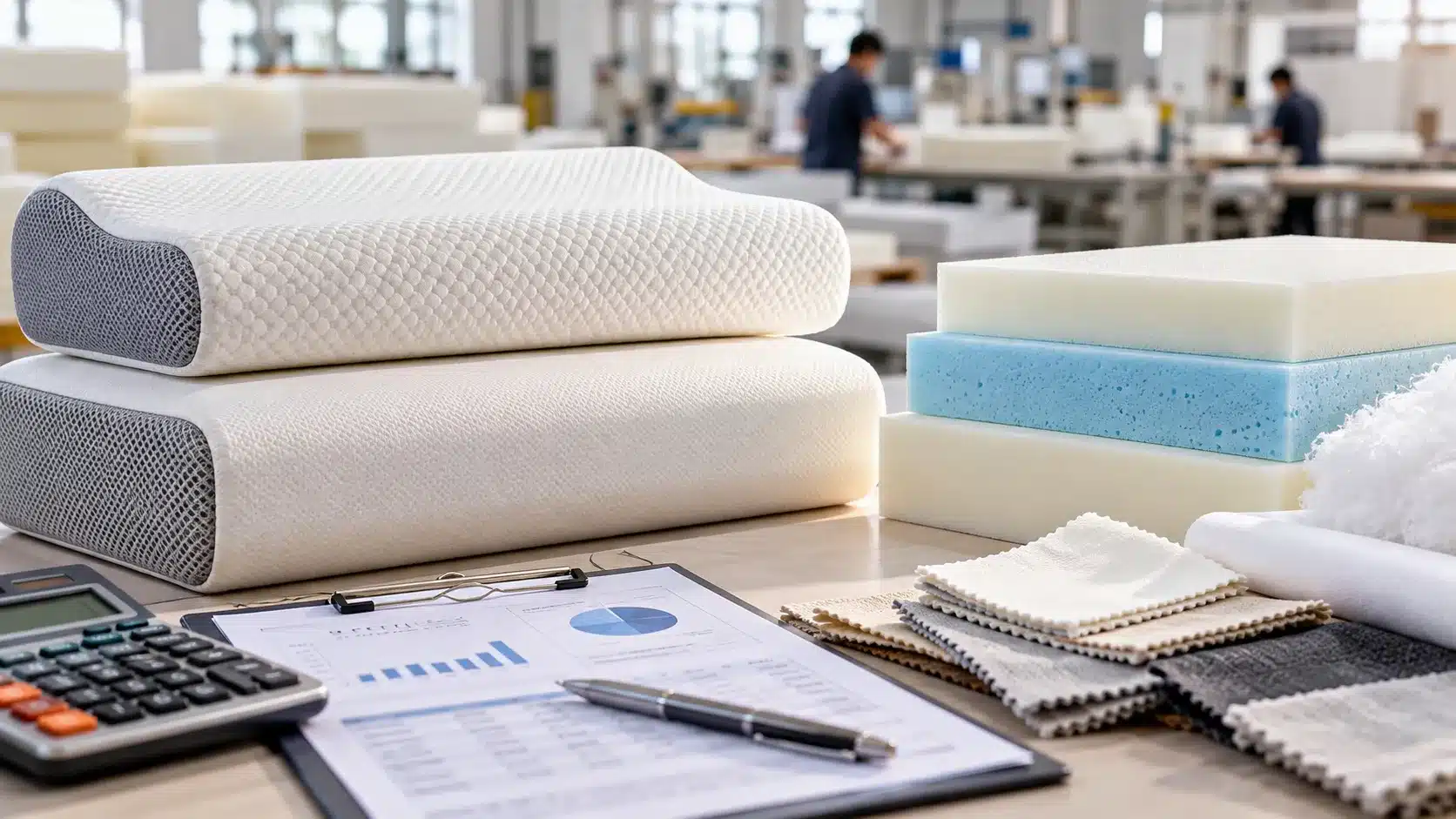
The cost to manufacture a memory foam pillow depends on more than just the size of the product. Foam type, density, shape, cover material, tooling, packaging, customization, and order quantity can all change the final unit price.
For pillow brands, Amazon sellers, importers, and distributors, the most useful approach is not to look for one fixed price. Instead, brands should understand what drives the cost and how each specification affects the final quotation.
Two pillows that look similar from the outside can have very different manufacturing costs because their internal materials and production requirements are different.
What Determines the Cost of a Memory Foam Pillow?
Several major factors influence manufacturing cost.
| Cost Factor | Typical Cost Impact |
|---|---|
| Foam type | High |
| Foam density | Medium to High |
| Pillow size | High |
| Mold or tooling | Medium to High |
| Cover material | Medium |
| Branding | Low to Medium |
| Packaging | Medium |
| Order quantity | High |
The largest cost differences usually come from foam, product size, tooling, cover specification, and production quantity.
Foam Type Is One of the Biggest Cost Factors
The foam core is one of the most important cost components of a memory foam pillow.
Standard Memory Foam
Standard memory foam is widely used for sleeping pillows, contour pillows, and ergonomic products.
It is usually easier to control from a cost perspective because the material is commonly produced and available in different density and firmness levels.
High-Resilience Foam
High-resilience foam provides faster recovery and more elastic support.
Depending on formulation and density, its cost may differ from standard memory foam, but it can be a good option for support-focused pillow designs.
Gel-Infused Memory Foam
Gel-infused foam is often used for cooling or premium product positioning.
Because it requires additional materials or specialized formulation, it may increase production cost compared with standard foam.
Bamboo Charcoal Foam
Bamboo charcoal memory foam is often used as a differentiated material option.
It can support premium positioning, but brands should evaluate whether the added material cost matches the target retail price.
You can compare these options in our guide on how to choose memory foam for pillows.
How Foam Density Affects Cost
Higher-density foam generally uses more raw material within the same volume.
This usually means:
- Higher foam cost
- Higher product weight
- Greater material consumption
- Potentially higher shipping weight
However, higher density does not automatically mean better value.
A pillow should use a density that matches its support level, durability target, and market positioning.
Our article on memory foam density for pillows explains how density affects pillow performance and product development.
Pillow Size and Thickness Affect Material Usage
Pillow dimensions have a direct effect on manufacturing cost.
A larger or thicker pillow requires more foam, more cover fabric, and often a larger package.
The main dimensions include:
- Length
- Width
- Height
- Contour height
- Foam volume
Even a small increase in thickness can create a noticeable cost difference when multiplied across a large production order.
For this reason, brands should avoid adding unnecessary height only to make the pillow look more premium.
Molded Pillow vs Cut Foam Cost
The production method also affects development cost.
Molded Memory Foam Pillows
Molded foam is common for:
- Contour pillows
- Neck pillows
- Cervical-style pillows
- Ergonomic shapes
These products often require a custom mold.
The initial development cost may include:
- Mold tooling
- Sample development
- Design adjustment
- Testing
However, molded production offers better consistency for complex shapes.
Cut Foam Pillows
Cut foam is more suitable for simple rectangular or block-style products.
It usually requires less tooling and allows easier dimension changes.
For brands testing a new product concept, cut foam can reduce initial development cost.
How Cover Materials Affect Pillow Cost
The pillow cover is another important cost factor.
Common materials include:
- Polyester knitted fabric
- Mesh fabric
- Cooling fabric
- Tencel
- Bamboo-style fabric
- Specialty textiles
The final cost also depends on:
- Fabric GSM
- Zipper type
- Inner liner
- Quilting
- Embroidery
- Printing
A premium cover may improve product appearance and perceived value, but it can also increase sewing and finishing costs.
How Custom Shapes and Designs Affect Cost
More complex pillow designs generally require more development work.
Examples include:
- Contour shapes
- Butterfly neck pillows
- Multi-height pillows
- Ventilation holes
- Zoned support designs
- Custom ergonomic curves
These designs may require new molds, more sampling, and additional testing.
Brands developing ergonomic products can review our neck pillow manufacturer page for different custom shape and foam options.
How Branding Affects Cost
Brand customization usually has a smaller impact than foam or product size, but it should still be included in the quotation.
Common branding options include:
- Woven labels
- Printed logos
- Embroidery
- Custom zipper pulls
- Instruction cards
- Branded packaging
In many projects, logo customization is not the main cost driver.
The bigger cost factors are usually foam, dimensions, cover material, packaging, and order quantity.
How Packaging Affects Manufacturing Cost
Memory foam pillows are often compressed to reduce shipping volume.
Common packaging options include:
- Vacuum compression
- Roll packing
- PE bags
- Retail boxes
- Shipping cartons
More advanced packaging can increase:
- Packaging material cost
- Printing cost
- Labor
- Carton size
Packaging should also be considered together with logistics.
A lower-cost package that reduces shipping volume can sometimes provide more total savings than a small reduction in material cost.
How MOQ Affects Unit Cost
Order quantity has a major effect on unit manufacturing cost.
Smaller orders usually have higher unit costs because:
- Material purchasing is less efficient
- Setup cost is divided across fewer units
- Packaging cost is higher per unit
- Tooling cost is spread across fewer products
Larger orders generally provide better cost efficiency.
However, there is no single fixed MOQ for every pillow project. The practical MOQ depends on material, design, cover fabric, packaging, and customization requirements.
How to Reduce Cost Without Reducing Product Quality
Brands can often reduce cost without simply choosing cheaper materials.
Effective strategies include:
Use Existing Foam Formulations
Using proven foam formulations can reduce development complexity.
Limit Initial SKUs
Launching too many sizes, colors, or firmness levels increases inventory and material complexity.
Use Standard Cover Materials
For first production runs, stock or commonly available fabrics can help control MOQ and cost.
Optimize Pillow Dimensions
Reducing unnecessary foam volume can lower both material and shipping costs.
Use Compression Packaging
Compression can significantly improve logistics efficiency.
Consider Existing Mold Designs
If an existing mold fits the product concept, it may reduce tooling cost and development time.
What Should Brands Confirm Before Ordering?
Before requesting a final quotation, brands should confirm:
- Foam type
- Foam density
- Pillow dimensions
- Firmness
- Mold requirements
- Cover material
- Logo method
- Packaging
- MOQ
- Carton dimensions
- Product weight
The more complete the specification, the more accurate the quotation will be.
Work With a Memory Foam Pillow Manufacturer
An experienced memory foam pillow manufacturer should help brands understand the full cost structure instead of simply providing one unit price.
A manufacturer with foam-processing experience can help optimize:
- Foam specification
- Density
- Pillow dimensions
- Mold design
- Cover materials
- Packaging
- Product weight
- Production quantity
This makes it easier to develop a pillow that fits both the target retail price and the expected quality level.
Conclusion
Memory foam pillow manufacturing cost is mainly determined by foam, size, mold, cover material, packaging, customization, and order quantity.
The cheapest specification is not always the best commercial choice.
Brands should focus on building a product whose manufacturing cost matches its target market, retail price, and product positioning.
By understanding the main cost drivers early in development, brands can make better design decisions and avoid unnecessary cost before mass production begins.