
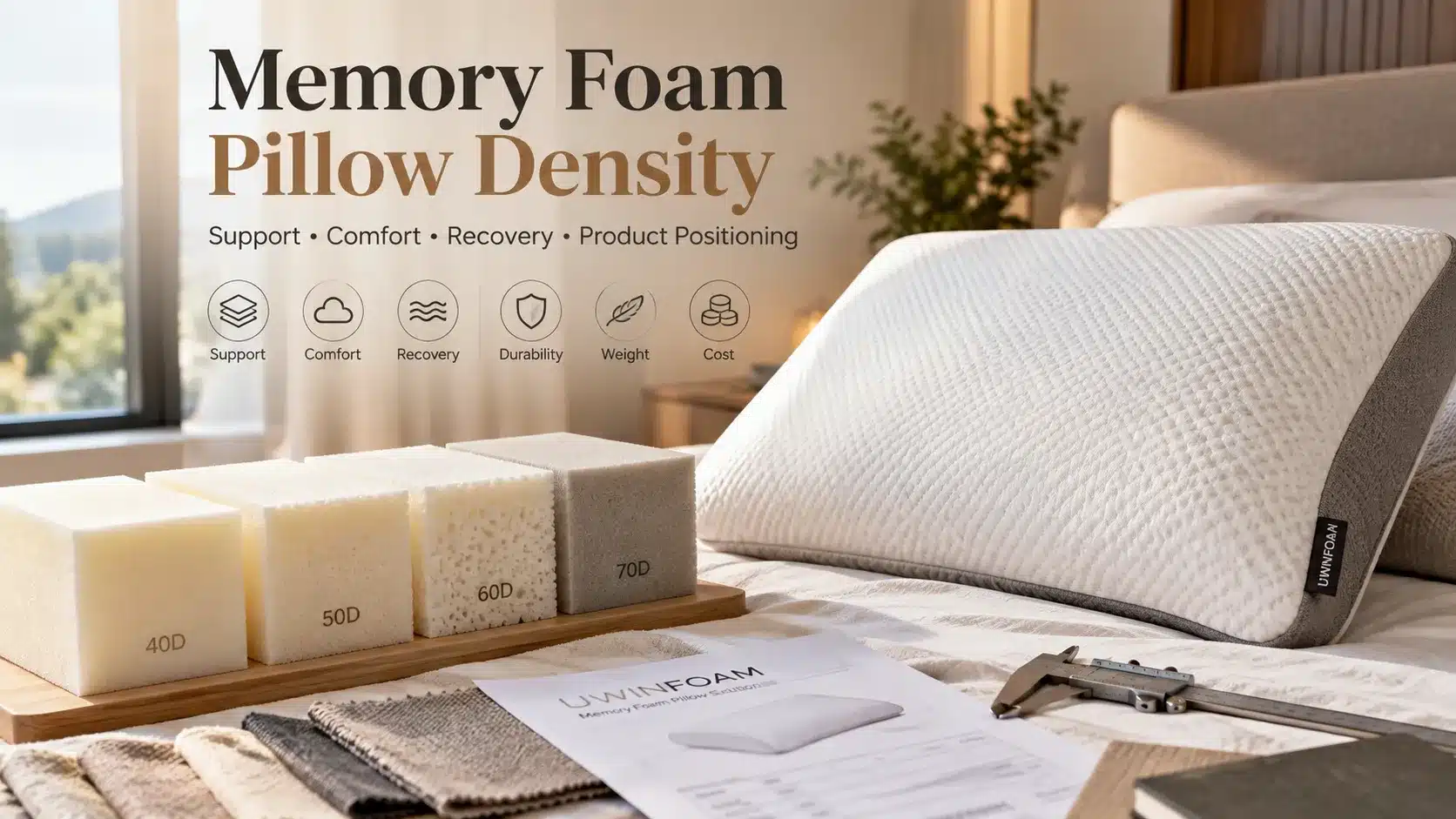
Choosing the right memory foam density is an important part of developing a pillow product. Density affects how substantial the foam feels, how well it maintains its shape, how much the finished pillow weighs, and how much it costs to manufacture.
However, higher density does not automatically mean better quality.
For pillow brands, Amazon sellers, and importers, the right density should match the pillow type, target comfort, support level, retail positioning, and packaging requirements.
What Does Memory Foam Density Mean for Pillows?
Memory foam density describes how much foam material is contained within a given volume.
In pillow development, density can influence:
- Product weight
- Durability
- Structural stability
- Compression resistance
- Cost
- Overall feel
However, density should not be used as the only indicator of pillow quality.
Brands that need a more general explanation of foam density can also review our foam density and chart.
For pillow development, the more important question is how density works together with firmness, shape, and foam formulation.
Memory Foam Density Is Not the Same as Firmness
One of the most common mistakes in pillow sourcing is treating density and firmness as the same thing.
They are different specifications.
Two memory foams can have similar density but feel very different because of differences in formulation, cell structure, and firmness.
A higher-density foam can still be designed to feel relatively soft, while a lower-density foam can be formulated to feel firmer.
Brands should therefore evaluate:
- Density
- Firmness
- Recovery speed
- Pressure response
- Pillow height
- Overall support
When approving a pillow sample, the final feel is more important than the density number alone.
How Density Changes Pillow Feel and Support
Density affects how substantial and stable the pillow feels during use.
Lower-density memory foam usually feels lighter and may compress more easily.
Medium-density foam often provides a good balance between comfort, support, weight, and cost.
Higher-density foam generally feels more substantial and can offer better long-term structural stability.
However, support also depends on pillow design.
For example, a contour neck pillow with a well-designed shape may provide better support than a flat pillow made with denser foam.
That is why brands should consider density together with product structure.
Choosing Density for Different Pillow Types
Different pillow categories require different density strategies.
| Pillow Type | Density Strategy | Main Development Focus |
|---|---|---|
| Standard Memory Foam Pillow | Medium-density balance | Comfort and cost |
| Contour Pillow | Medium to higher density | Shape stability and support |
| Neck Pillow | Support-focused density | Ergonomic structure |
| Cooling Pillow | Balanced density | Support plus airflow |
| Travel Pillow | Lighter density may help | Weight and portability |
| Premium Pillow | Higher-density or specialized foam | Durability and positioning |
A standard sleeping pillow usually needs a different foam specification from an ergonomic neck pillow.
For brands developing cervical or contour designs, our neck pillow manufacturer page shows several foam and structure options used in customized neck pillow products.
Density and Pillow Height Should Be Planned Together
Foam density should not be selected separately from pillow height.
A relatively high pillow with dense memory foam may feel too supportive for some target customers, while a lower pillow using softer foam may feel more comfortable.
Brands should consider:
- Pillow height
- Shoulder width
- Sleeping position
- Target firmness
- Contour shape
- Foam density
For contour pillows, the height difference between the high and low sides also affects the final support level.
This is especially important when developing multiple pillow sizes or different firmness versions.
Molded Memory Foam vs Cut Memory Foam
The manufacturing method also affects how density should be selected.
Molded Memory Foam
Molded foam is commonly used for contour pillows, neck pillows, and ergonomic shapes.
It offers:
- Consistent shape
- Complex curves
- Better design repeatability
- Suitable support zones
Because the shape itself contributes to support, density can be selected together with mold design and foam firmness.
Cut Memory Foam
Cut foam is often used for simpler rectangular or block-style pillows.
It offers:
- Flexible dimensions
- Lower tooling requirements
- Easier size adjustment
- Straightforward production
For brands testing a new pillow concept, cut foam can sometimes reduce initial development complexity.
How Density Affects Pillow Cost
Foam density has a direct impact on material usage.
Higher-density foam contains more material within the same volume, which usually increases foam cost and finished product weight.
Brands should therefore match density with product positioning.
For an entry-level pillow, using an unnecessarily high-density foam may increase cost without creating enough additional value for the customer.
For a premium pillow, a higher-density or specially formulated foam may support a stronger product positioning.
The goal is to balance:
Comfort + Durability + Cost + Retail Price
rather than simply choosing the highest available density.
How Density Affects Compression Packaging
Memory foam pillows are often compressed or roll packed to reduce shipping volume.
Density can influence:
- Compression ratio
- Recovery time
- Shape restoration
- Finished package weight
- Foam performance after storage
A denser pillow may compress well, but it can also increase shipping weight.
Brands should test how the pillow performs after being compressed for a realistic storage period.
After unpacking, the pillow should recover its intended height and shape without permanent deformation.
What Should Brands Test During Sampling?
Density should never be approved from a specification sheet alone.
During sampling, brands should test the actual finished pillow.
Important items include:
- Foam density
- Firmness
- Pillow height
- Recovery speed
- Shape retention
- Compression recovery
- Product weight
- Surface feel
- Odor
- Cover fit
- Packaging performance
For molded pillows, brands should also check whether the final shape is consistent with the approved design.
A pillow may meet the density specification but still fail to deliver the intended comfort or support.
How to Choose Density by Product Positioning
The right density depends heavily on how the pillow will be sold.
Entry-Level Products
Focus on:
- Cost control
- Lightweight construction
- Basic comfort
- Efficient packaging
Mid-Range Products
Focus on:
- Balanced support
- Better durability
- Stable recovery
- Competitive pricing
Premium Products
Focus on:
- More refined foam feel
- Better shape stability
- Specialized formulations
- Stronger product differentiation
Premium positioning may also include gel-infused foam, cooling foam, bamboo charcoal foam, or customized formulations.
Work With an Experienced Memory Foam Pillow Manufacturer
An experienced memory foam pillow manufacturer should help brands evaluate more than density alone.
The manufacturer should be able to adjust:
- Foam density
- Firmness
- Pillow height
- Molded shape
- Foam formulation
- Compression performance
- Cover compatibility
- Product cost
For new products, sampling several foam options can be more useful than selecting one density based only on a technical specification.
This allows brands to compare actual feel, recovery, support, and packaging performance before mass production.
Conclusion
The best memory foam density for a pillow is not necessarily the highest density.
The right choice should match the pillow type, support target, comfort level, height, product positioning, cost, and packaging method.
For brands developing memory foam pillows, density should always be evaluated together with firmness, shape, and real sample performance.
By testing these factors as a complete system, brands can develop pillows that are more consistent, commercially realistic, and better suited to their target market.