Your Trusted Private Label Acoustic Foam Manufacturer
We make it easy for you to build your brand by providing end to end solution to your private label OEM/ODM production.
We ensure that every OEM/ODM Acoustic Foam with design and comfort will stand out.
Union-win specializes in private label Acoustic Foam customization, offering a variety of styles, fabric appearances, and comfort solutions.
We provide Private Label Acoustic Foam with a broad range of designs, packaging, and customization options to meet diverse client needs.
Additionally, we leverage a strong supply chain to deliver extensive packaging customization services for your Acoustic Foam , ensuring every detail aligns with your brand.
Acoustic Foam
SP23080101(8cm)
Acoustic Foam
SP23080102(5cm)
Acoustic Foam
SP23080201(2/4/5cm)
Acoustic Foam
SP23080301
Acoustic Foam
SP23080302
Acoustic Foam
SP23080304
Acoustic Foam
SP23080305
Acoustic Foam
SP23080308
Acoustic Foam
SP23080401(2.5/5cm)
Acoustic Foam
SP23080402
Acoustic Foam
SP23080501
Acoustic Foam
SP23080502
Acoustic Foam
SP23080503
Acoustic Foam
SP23080504
Acoustic Foam
SP23080601
Acoustic Foam
SP23080701
Acoustic Foam
SP23080801
Acoustic Foam
SP23080901
Acoustic Foam
SP23080904
Acoustic Foam
SP23080905
Union-win offers you complete flexibility to choose any fabric or style design you prefer for your private label Acoustic Foam, and we will handle the rest.
Below are some of our best-selling fabric options and style designs for Acoustic Foam , available for your private label customization.
As a private label home goods manufacturer, Union-win has a professional team of experienced engineers, designers, sales consultants, and production experts dedicated to the research and development of Acoustic Foam /Massage Bed and other related products. With state-of-the-art equipment and testing capabilities, we ensure high-quality production and packaging services.
Our mission is simple: to turn your ideas into reality.
Fire-proof foam
Memory Foam
High Density Foam
High Density Foam
Hey, don't hesitate to try & feel the FREE SAMPLES before making up your decision
Find A Quality Manufacturer For Your Acoustic Foam
Reasons to choose union-win as your private label manufacturer
Source factory
Self-produced Raw Materials
CNC Cutting Equipment
Foaming line
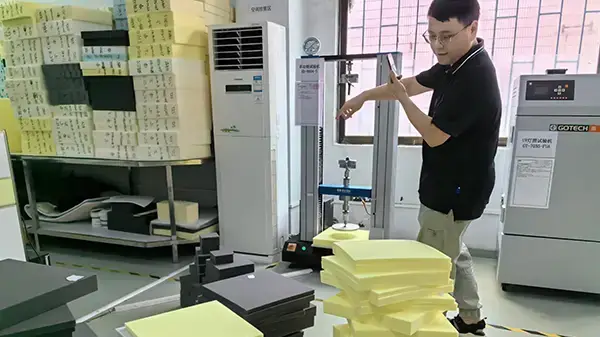
Testing machine
Certified Laboratory
You can totally trust us with all certifications shown below
Acoustic Foam Manufacturer Production Process
Quality is our fundamental principle, and the stone of win-win cooperation. It requests completed production process and patient and responsible QC team.
1. Raw Materials
2. Foaming Process
3. QC on Foam
4. Speical shape foam cutting
5. Foam cutting
6. Fabric Cutting
7. Sewing
8. Filling shredded foam
9. Finished Product
10. Quality Checking
11. Packing
12. Ready to Ship
Hear from our clients
Our clients love working with us, just read what they have to say!
As a foam sponge buyer in the United States specializing in pet supplies, my experience with Union-Win has been nothing short of exceptional. Over the past year, we've imported a variety of pet products from Union-Win, including their innovative plush blanket-style pet mats, and the quality has consistently surpassed our expectations.
More Things About Acoustic Foam
Table of Contents
Acoustic Foam: Everything You Need to Know
Acoustic foam is a specialized polyurethane foam designed to absorb sound waves, reduce echo, and improve room acoustics by minimizing unwanted sound reflections. It is widely used in recording studios, home theaters, office spaces, and industrial settings to enhance sound clarity and control noise levels.
How Acoustic Foam Works
Acoustic foam functions by:
- Absorbing Sound Energy – The open-cell structure of the foam allows sound waves to enter, where they are gradually dissipated as heat.
- Reducing Reflection & Echo – Instead of bouncing off hard surfaces (like walls or ceilings), sound waves get trapped in the foam.
- Minimizing Reverberation – The foam helps control the lingering sound in a room, making speech or music clearer.
Types of Acoustic Foam
1. Based on Design & Structure
- Based on Design & Structure
- Wedge Foam 🔶 – Common in studios, effective in reducing mid-to-high frequencies.
- Pyramid Foam 🔺 – Increases the surface area for enhanced sound absorption.
- Egg Crate Foam 🥚 – Budget-friendly, provides moderate diffusion.
- Bass Traps 🎶 – Placed in corners to absorb low-frequency sounds.
- Ceiling Clouds & Acoustic Panels ☁️ – Suspended foam panels for large spaces.
2. Based on Material Composition
- Polyurethane Acoustic Foam (PU Foam) – The most commonly used material with good sound absorption properties.
- Melamine Foam – Lightweight and flame-resistant, used in high-end acoustic treatment.
- Polyester Fiber Panels – Non-toxic and eco-friendly, ideal for home or office use.
- Fiberglass Acoustic Panels – Provides superior sound absorption but requires protective covering to avoid fiber shedding.
Acoustic Foam vs. Soundproofing Foam
Acoustic foam absorbs sound to improve room acoustics, while soundproofing materials block sound transmission from one space to another. If the goal is to prevent noise leakage, mass-loaded vinyl (MLV), rock wool, or drywall layering is more effective than acoustic foam alone.
Advantages of Acoustic Foam
✅ Improves Sound Clarity – Essential for recording studios, home theaters, and offices.
✅ Lightweight & Easy to Install – Comes in peel-and-stick panels or tiles.
✅ Customizable Designs – Available in various shapes, colors, and thicknesses.
✅ Fire-Retardant Options – Safer for public spaces and professional studios.
Common Applications
Home Theaters – Enhances audio experience by reducing unwanted reflections.
Recording Studios – Provides a controlled sound environment for clear recordings.
Gaming & Streaming Rooms – Helps in minimizing echo and outside noise.
Office Spaces & Call Centers – Reduces noise pollution for better communication.
Industrial Sound Control – Used in machinery rooms to dampen loud noises.
How to Choose the Right Acoustic Foam
When selecting acoustic foam, consider:
- Foam Thickness – Thicker foam absorbs lower frequencies (e.g., 2” to 4” for bass absorption).
- Foam Density – Higher-density foam provides better sound absorption.
- Fire-Retardant Properties – Essential for commercial applications.
- Room Size & Purpose – Different rooms require different acoustic treatments.
Installation Tips
- Use spray adhesive, double-sided tape, or mounting clips for easy application.
- Cover corners and reflective surfaces first to maximize efficiency.
- Pair with bass traps and diffusers for a well-balanced acoustic environment.
Potential for Production
Since you specialize in polyurethane foam manufacturing, acoustic foam could be a profitable product line! You could develop:
- Custom-cut acoustic panels
- Fire-resistant foam for commercial use
- Eco-friendly acoustic solutions
Most Asked Questions About OEM ODM Private Label Acoustic Foam
Are you interested in creating a private-label Acoustic Foam but don’t know where to start?
Here are 10 FAQs to help guide you through the process:
1. What is the difference between OEM, ODM, and Private Label for Acoustic Foam? OEM (Original Equipment Manufacturer)
OEM (Original Equipment Manufacturer)
Buyers provide custom designs and technical specifications, and the supplier manufactures the product accordingly. This option is best for brands seeking exclusive and innovative Acoustic Foam products.
ODM (Original Design Manufacturer)
The supplier offers pre-designed Acoustic Foam solutions that can be customized with different sizes, densities, colors, and patterns. This approach saves time and production costs while allowing moderate customization.
Private Label
Buyers select an existing Acoustic Foam product and add their brand name, logo, and packaging. This is the fastest and most cost-effective way to enter the acoustic treatment market with a branded product.
Which Option is Best?
- OEM: Best for unique, fully customized Acoustic Foam solutions.
- ODM: Ideal for modifying an existing design with brand-specific features.
- Private Label: Perfect for quick market entry with minimal development costs.
2. What customization options are available for Acoustic Foam?
Buyers can customize multiple product attributes, including:
Foam Type – Polyurethane (PU Foam), Melamine Foam, or Fiberglass Acoustic Panels.
Thickness & Density – Choose 1”, 2”, 3”, or 4” for different levels of sound absorption.
Shapes & Surface Patterns – Wedge, Pyramid, Egg Crate, Bass Traps, and Flat Panels.
Color Options – Standard black, gray, blue, or fully custom colors to match brand identity.
Fire-Retardant Features – Meets safety standards like CA117, BS5852, and FMVSS 302.
Packaging & Branding – Custom printed boxes, labels, instruction manuals, and barcode stickers for retail or e-commerce sales.
3. What certifications are required for Acoustic Foam products?
To ensure compliance with international safety and quality standards, look for the following certifications:
Fire Retardancy – CA117 (USA), BS5852 (UK), FMVSS 302 (Automotive).
Environmental Safety – CertiPUR-US, OEKO-TEX, RoHS.
Acoustic Performance – NRC (Noise Reduction Coefficient) rating.
Tip: If you plan to sell in Amazon, Walmart, or international markets, ensure your Acoustic Foam meets all necessary certifications for regulatory compliance.
4. How to choose the best Acoustic Foam material for your brand?
- PU (Polyurethane) Foam – The most affordable and versatile choice for studios and home theaters.
- Melamine Foam – Lightweight, fire-resistant, and ideal for high-end acoustic applications.
- Fiberglass Acoustic Panels – Superior sound absorption but requires a protective fabric layer.
Best Choice Based on Application:
- Recording studios & home theaters – PU Foam (Wedge or Pyramid style).
- Commercial & industrial spaces – Melamine Foam for fire safety compliance.
- Professional soundproofing – Fiberglass panels for maximum noise reduction.
5. What is the MOQ (Minimum Order Quantity) for OEM & Private Label Acoustic Foam?
The MOQ depends on the level of customization:
Private Label (Logo & Packaging Only) – 100-500 units.
ODM Custom Shapes & Colors – 500-1,000 units.
OEM (Fully Custom Design & Formula) – 1,000+ units.
6. What are the packaging options for private-label Acoustic Foam?
Buyers can choose from:
Vacuum-compressed packaging – Saves shipping costs and space.
Shrink-wrap & plastic bags – Budget-friendly for bulk orders.
Custom-branded boxes – Includes logo, instructions, and barcodes, ideal for e-commerce and retail.
7. Can I get free samples before placing a bulk order?
Yes, most manufacturers provide free or low-cost samples before mass production.
However, buyers may need to cover shipping fees for international deliveries.
Tip: Always test foam density, absorption performance, and fire-retardant properties before committing to bulk orders.
8. How long does it take to manufacture and ship custom Acoustic Foam?
Production Time:
- Standard Private Label – 7-15 days.
- OEM/ODM Custom Orders – 20-30 days, depending on complexity.
Shipping Time:
- Air Freight – 5-10 days (faster but higher cost).
- Sea Freight – 25-45 days (cost-effective for bulk orders).
9. What branding options are available for private-label Acoustic Foam?
Buyers can enhance their brand visibility through:
Custom Logo Printing – Printed directly onto foam or packaging.
Branded Labels & Stickers – Essential for Amazon FBA, Walmart, and retail chains.
Custom Box Packaging – High-end branding for premium market positioning.
10. How can I start my own Acoustic Foam brand with OEM/ODM services?
📌 Step 1: Choose the foam type, thickness, and shape for your brand.
📌 Step 2: Select branding elements (logo printing, custom packaging).
📌 Step 3: Request samples to test quality and performance.
📌 Step 4: Confirm MOQ, pricing, and production timeline.
📌 Step 5: Approve mass production and arrange shipping.
📌 Step 6: List your product on Amazon, Walmart, Shopify, or wholesale channels.